
the brightworks arc
the framework of a rigorous education
“Project Based Learning is a teaching method in which students gain knowledge and skills by working for an extended period of time to investigate and respond to an authentic, engaging, and complex question, problem, or challenge.”
-The Buck Institute for Education
This methodology creates an ecosystem for students to learn by actively engaging in real-world and personally meaningful projects. By centering student agency and cognitive challenge, we have built a unique foundation that has attracted the attention of educators worldwide.
A Paradigm Shift: From Industry 3.0 to Education 4.0
While traditional schools were designed for the industrial age of compliance, Brightworks aligns with the World Economic Forum’s Education 4.0 initiative. We focus on the "Global Citizenship" and "Innovation" skills—critical thinking, complex problem solving, and social-emotional intelligence—that are the primary currencies of the 21st century.
The Foundation of Joy and Rigor
At its core, Brightworks is an engagement-driven school. Our pedagogy is rooted in Neuroscience, which demonstrates that "joyful rigor" is not a paradox, but a requirement for deep learning. By prioritizing Dopamine-Driven Inquiry, we ensure students remain in a state of "flow," where the brain is most receptive to memory consolidation and the "productive struggle" of complex tasks. We emphasize process over product to help students:
Think critically and explore deeply.
Challenge themselves and learn from both failure and success.
Contribute positively to society through intentional action.
The Arc: Our Pedagogical Engine
To guide our students in this journey, we follow what we call the Arc. This framework replaces rote memorization with a three-phase inquiry cycle designed to build stamina, empathy, and intellectual agility.
1. Exploration: Inquiry and Wonder
The Arc begins by centering real-world experiences and open-ended questions. Drawing on Harvard Project Zero’s "Visible Thinking" routines, students engage in immersive primary research to build a shared vocabulary of knowledge. Rather than memorizing facts, they learn how to ask the right questions.
2. Expression: Embodied Construction
During this phase, students move into "the Shop"—a high-cognitive laboratory where they apply their knowledge. Through group work and individual passion projects, students make their thinking visible. This phase focuses on Embodied Cognition, where the physical act of building and prototyping creates more robust neural pathways than traditional lecture-based learning. It is here that students unleash their potential to refine their talents and apply knowledge to tangible problems.
3. Exposition: Public Demonstration of Understanding
The cycle concludes with a public defense of the work. Following the gold standard of Project-Based Learning (PBL Works), students justify their technical and intellectual choices to an audience of peers and experts. This serves as a summative assessment that measures agency and intention rather than standardized test-taking skills.
The Role of the Collaborator
Our educators are not "lecturers" but Collaborators and Facilitators of Inquiry. They strive to build bonds with the students, challenge them, support them, and create with them so each student can find the most beautiful version of themselves.
The Outcome: Agency and Impact
Our graduates are the kinds of lifelong learners required for success in the balance of the 21st century. Their education at Brightworks has built a sense of agency and a drive to pursue what they are most passionate about—because we know that passion and drive lead to change and making the world a better place.
A growing body of research shows that project-based learning can have a positive impact on achievement and engagement. Linda Darling-Hammond at Stanford describes how a rigorous project-based approach fits in with what we know works for students.

We learn by exploring
We learn by collaborating
We learn through projects
The Brightworks Arc
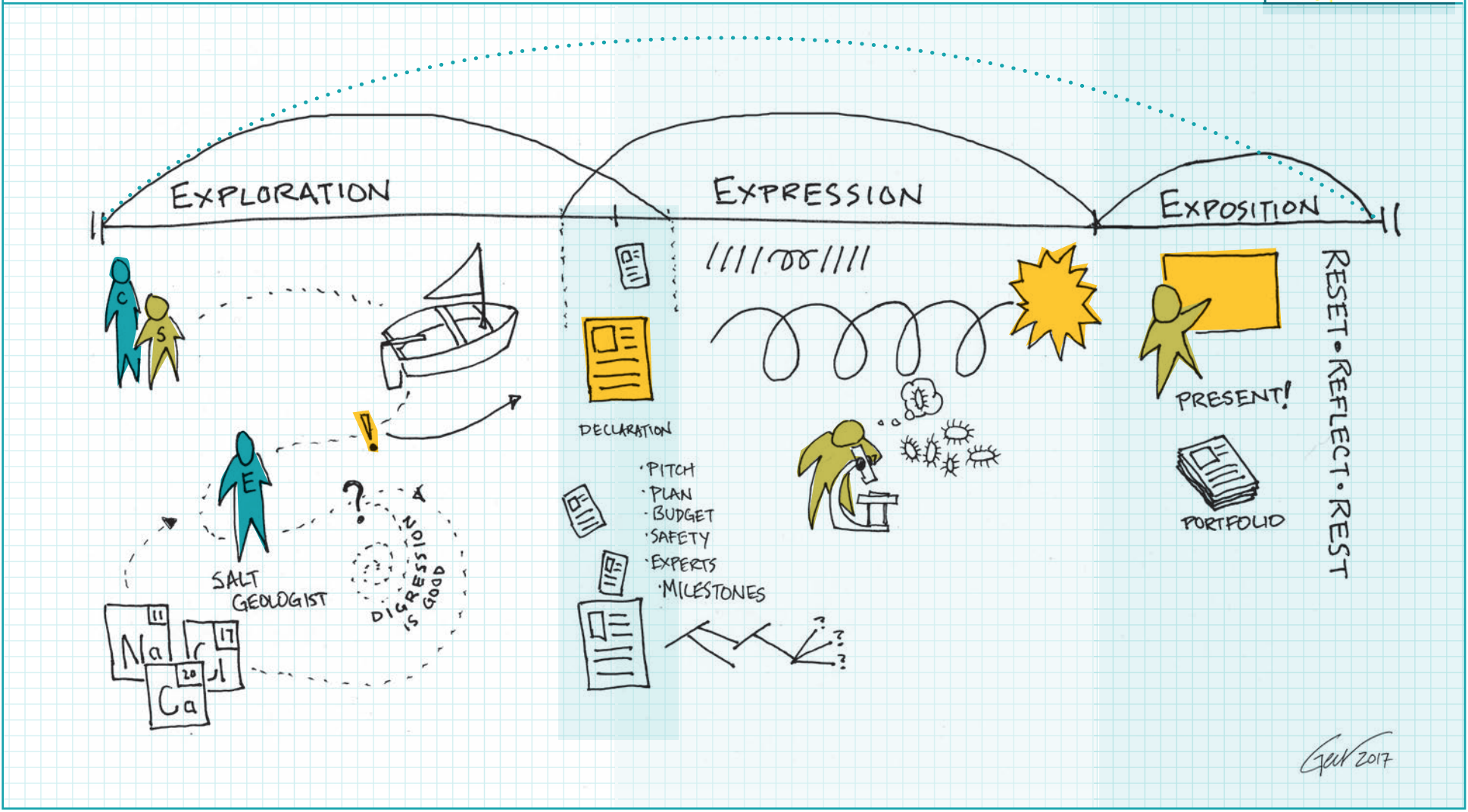
The Arc is the fundamental rhythm of a Brightworks education. With two to three major arcs each year, students move through a diverse course of study in a series of intensive immersions, emphasizing depth over breadth, integrating and contextualizing the development of skills and domain knowledge.
The Arc allows students to contextualize their learning in real-world scenarios and connections between ideas, which creates pathways in the brain for longer-lasting learning.
Each arc is framed by a specific topic that each student, kindergarten through high school, approaches at a level and perspective appropriate to their age.
Exploration

The beginning phase of the arc is Exploration, a time to delve into the fundamental questions about a topic - What is it? What does it mean? Why is it important? Central to Exploration is a group project that gives students motivation and context for the core skills that they are developing. This is a time to model of the important aspects of project work, like collaboration, growth mindset and project management.
Expression

In the next phase of the arc, Expression, students build on what they learned in Exploration by creating anything from a structure or art object to an experiment, a research project, or a performance, centered around whatever facet of the arc topic has caught their intellectual interest. Collaborators and experts support students in project management, documentation, collaboration, and specific skills to complete their project.
Exposition

The final phase, Exposition, requires students explain their work to their community and themselves through written and oral presentations, question sessions, and demonstrations. In doing so they develop robust and flexible communication skills and integrate their most recent work into their continuing intellectual and social-emotional growth.

The Arc for early elementary students looks a little different.
Through play and provocations, our youngest students explore ideas, materials, and questions. This exploration leads to discovery related to the arc topic. Through those discoveries, students collaborate to create an artifact that is a reflection of their learning.
They test these prototypes, give and receive feedback, then continue to work together to finalize their group project. During Expo night, students share their findings and their creations. This process lays the foundation for individual projects in the later elementary years.
-
![Children and an adult outside in a wooded yard, some children sitting and others standing, engaging in an activity led by the adult.]()
Dream it.
-
![Two children working on an art project with a large, colorful paper mache fish on the table, surrounded by torn paper, scissors, and art supplies in a room with wood-paneled walls.]()
Build it.
-
![A young girl wearing safety glasses, ear protection, and a purple jacket is cutting wood with a yellow power saw on a workbench in a workshop.]()
Make it.
-
![Two children smiling and looking at a small robotic vehicle on a table in a classroom.]()
Share it.


