
Academics Woven into Projects
The Wheel Arc Exploration Phase is underway!
During this time, students explore all the permutations of a topic. They're flexing their perspectives, learning from one another, and following questions wherever they lead.
If you're new to the Brightworks rhythm: an Arc is our multi-week immersive investigation into a single topic. It's the shape that holds everything — our academic work, our making, our questions, and our field study. Wheel is where we begin this year.
New to Arcs, or curious what a launch actually looks like from the inside? Our latest blog post walks through how one starts: Progressive education in action: the Wheel Arc →
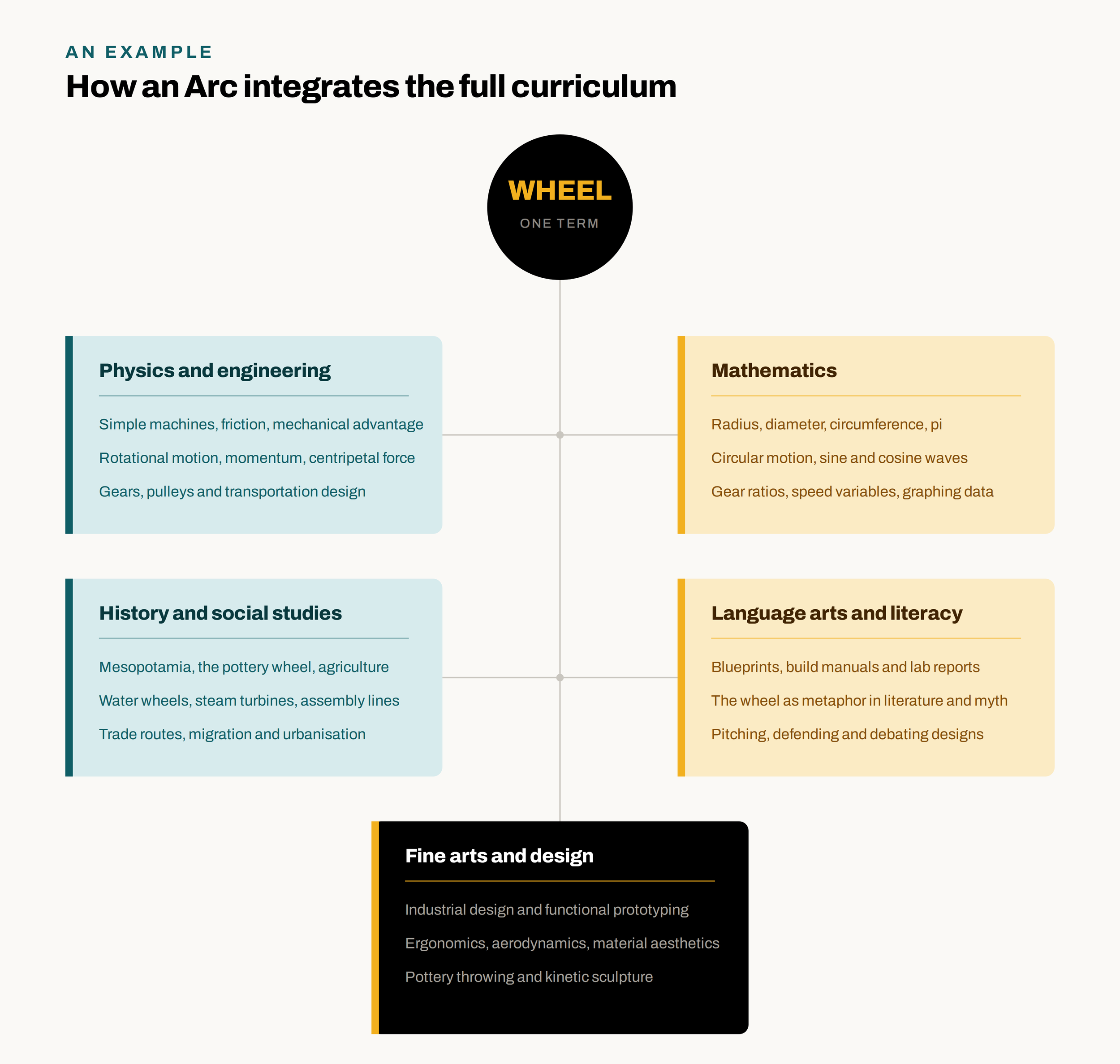
Here is a comprehensive visual breakdown of how a project-based curriculum centered on the theme of the Wheel can map naturally to the traditional academic subjects.
STEAM
Physics & Engineering
Simple Machines: Investigating the physics of the wheel and axle, mechanical advantage, and friction reduction.
Kinematics & Rotational Motion: Studying angular velocity, momentum, and centripetal force.
Transportation Technology: Challenges around gears, pulleys, and the mechanics of bicycles or automobiles.
Fine Arts & Design
Industrial Design: Prototyping functional wheeled objects, focusing on ergonomics, aerodynamics, and material aesthetics.
Visual Arts: Practicing pottery throwing on a wheel, drawing perspective wheels, or exploring kinetic art and mobile sculptures.
Mathematics
Geometry: Calculating radius, diameter, circumference, area, and exploring the properties of Pi (π).
Trigonometry: Mapping circular motion to sine and cosine waves, and tracking rotational coordinates.
Data & Graphing: Measuring gear ratios, tracking speed variables, and analyzing efficiency data through graphs.
Language Arts & Literacy
Technical Writing: Drafting step-by-step blueprints, building manuals, and lab reports for wheeled prototypes.
Literature & Mythology: Analyzing the metaphor of the wheel in literature (e.g., the "Wheel of Fortune" in folklore or Tuck Everlasting).
Persuasive Speaking: Pitching engineered wheel designs or debating the environmental impact of tire manufacturing.
History & Social Studies
Ancient Civilizations: Tracking the invention of the pottery wheel and wheeled carts in Mesopotamia, and their impact on agriculture.
The Industrial Revolution: Examining the evolution of water wheels, steam turbines, and assembly line conveyor belts.
Human Geography: Analyzing how the wheel revolutionized global trade routes, migration patterns, and urbanization.
Here is a peek at how wheels were explored last week across the school.
Early Elementary: Our 5-6 year olds created a color wheel that became a perpetual calendar.
Upper Elementary: Our 10-11 year olds built car prototypes to race down ramps (secret math provocation!) and iterated to improve their times.
Middle School: 12 & 13 year olds made their own drop spindles.
High School: Our 9-12th graders are working on a communal seating prototype.
Home - School Connection
If your learner has caught the Wheel bug and you'd like to follow it at home, PBS has a good collection of wheel-related programming. Browse it here →